Introduction
Some things were never meant to stay in the past.
The norigae — a traditional Korean pendant worn on the loops of a hanbok ribbon — has decorated Korean women for over a thousand years. Crafted from jade, coral, amber, and the luminous iridescence of jagae (자개, mother-of-pearl), it was never just decoration. Each piece told a story: of protection, of fortune, of a life lived with intention.
And right now, in 2025, that story is being told louder than ever.
What Is a Norigae — And Why Does It Matter?
The word norigae (노리개) comes from the Korean verb 'to play' — norida — and these ornamental pendants were considered living companions as much as accessories. Worn by queens and commoners alike, they dangled from the chima (skirt) or jeogori (jacket) of the hanbok, catching light, announcing movement, whispering status.
The cord (끈, kkeun): Woven in specific colours to mark the wearer's rank and occasion. Red for celebration. Blue for calm. Gold for royalty.
The pendant (패물, paemul): The centrepiece — often jade, amber, silver, or for the most treasured pieces, jagae. The material was chosen to attract specific blessings.
The tassel (술, sul): Silk threads that swayed with each step — a gentle kinetic reminder that beauty is meant to be lived in, not preserved behind glass.
To wear a norigae was to carry ancestral intention on your body. It was Korea's original statement piece.

Jagae (자개) — The Art That Shines Like the Moon
Mother-of-pearl — called jagae in Korean — has been used in Korean craft for over 1,400 years. The technique of najeonchilgi (나전칠기), inlaying thin iridescent shell into lacquerwork, was so prized that Korean artisans sent their pieces as diplomatic gifts to Chinese emperors.
But jagae is not just visually extraordinary. It is alchemical. The shell of the abalone or turbo snail is made of microscopic crystalline layers — and when light passes through them, it bends and scatters into a shifting spectrum of greens, blues, purples, and golds. No two angles produce the same colour. No two pieces of jagae look identical.
In traditional craft philosophy, this quality was considered divine — a material that contained the sea, the moon, and the sky simultaneously. To wear jagae was to carry something alive.

Meet heemuse — Where the Old World Meets Now

heemuse is a Korean craft brand that has done something quietly radical: taken the norigae and the ancient craft of jagae, and made them for this moment.

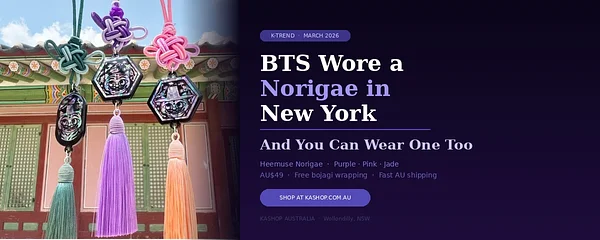
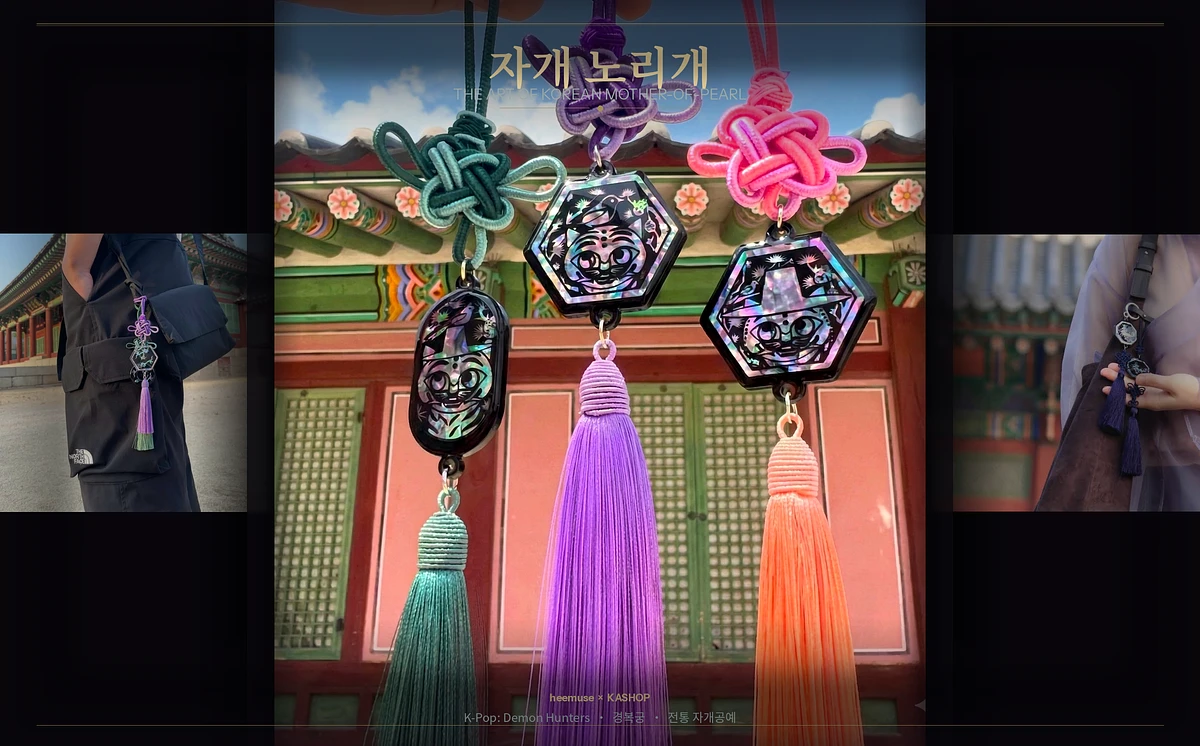
Their collection features hand-cut mother-of-pearl inlaid with extraordinary precision into custom-designed pendants. Each piece is strung with traditional Korean knotting (매듭, maedeup) — a craft in its own right — in bold, contemporary colours: deep teal, electric purple, hot pink, and blush coral.

The result is something that feels ancient and entirely contemporary at once. Something your grandmother might have recognised and your best friend immediately wants to steal.

As Seen in K-Pop: Demon Hunters — Derpy & Sussie
When Netflix's K-Pop: Demon Hunters arrived, it wove Korean shamanic tradition and folk iconography into its world with unexpected depth and beauty. The tiger and magpie — both central to Korean folk cosmology — appeared throughout as symbols of spiritual protection.
For many international viewers, it was a first glimpse into the visual language of Korean minhwa (민화) and folk belief. For Koreans, it was recognition: the ancestral symbols of their grandparents' village paintings, suddenly rendered in full cinematic colour and reaching a global audience.
heemuse's K-Pop: Demon Hunters collection features Derpy and Sussie — the series' beloved tiger characters — rendered in shimmering jagae on hexagonal and oval pendants. The iridescent mother-of-pearl gives the characters an otherworldly, supernatural glow that feels entirely at home in the Demon Hunters universe.

Five Ways to Style Your Norigae in 2025
One of the things that makes heemuse's norigae so compelling is their versatility. This isn't a piece that lives in a box. It moves with you.
As a bag charm: Loop onto a crossbody, backpack, or tote. The maedeup knot means it won't slip, and the tassel adds movement with every step.
As a hair accessory: Wrap around a scrunchie or hair tie for a stunning ponytail or braid accent — as seen on the streets of Gyeongbokgung.
As a clothing ornament: Clip onto a waistband, belt loop, or lapel — exactly as the original hanbok norigae would have been worn.
As a phone charm: Attach to your phone case for an instant dose of Korean craft that goes everywhere you do.
As a modern necklace: Wear the full piece as a long pendant necklace — the jagae medallion sits beautifully against a plain tee or a structured jacket.


A Cultural Moment: Gyeongbokgung and Korean Pride
Korea's ancient royal palace, Gyeongbokgung (경복궁), has become the most powerful stage in Korean cultural storytelling. When artists and creators gather there — when ordinary people choose it as their backdrop — they are making a declaration: this beauty belongs to the world now.
The norigae, the tiger, the magpie, the palace — these are not separate stories. They are verses in the same song: one about a culture that has never stopped creating, and is only now being fully seen.
Wearing a piece of heemuse jagae at Gyeongbokgung is, in its own small way, participating in that story.
Wear Something That Was Always Meant to Last
There is a Korean concept — orae doeda (오래되다) — that describes something that has endured, matured, and become more itself with time. Not old. Endured.
The norigae is orae doen art. The jagae is orae doen craft. And heemuse has created something that honours exactly that.
At KASHOP, we source from independent Korean makers who are doing exactly this — keeping craft alive by making it present. heemuse's jagae norigae collection is available now, limited in number, and made to last long beyond the trend that brought it to your attention.
Some things were never meant to stay in the past. This is one of them.